Dec 24, 2016

Daily Current Affairs for Competitive Exams: December 14, 2016

Hello readers,
Here are today's important headlines with key details for UPSC, SSC, IBPS and other competitive examinations.

National 

India-Russia Naval Exercise ‘Indra’ begins in Bay of Bengal
  • The 9th edition of Indra Navy exercise between Indian Navy and Russian Navy began today, December 14, 2016, in the Bay of Bengal. This annual bilateral maritime exercise will continue till December 21, 2016. The main aim of this exercise is to enhance the inter-operability between the two navies and develop a common understanding for maritime security operations.
Highlights: 
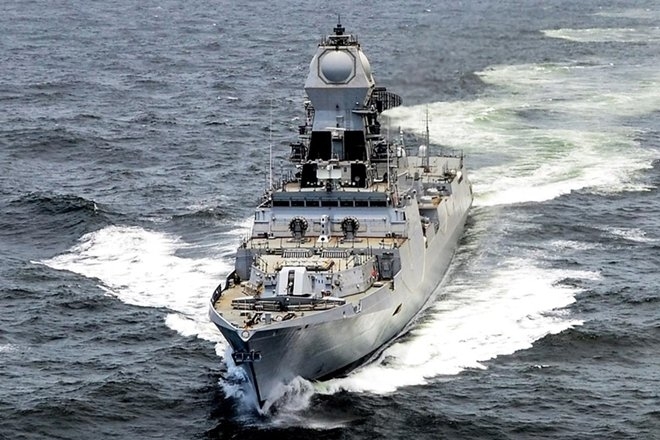
  • The Indian Navy will be represented by guided missile destroyer INS Ranvir, indigenous frigate INS Satpura and indigenous Anti-Submarine Warfare (ASW) corvette INS Kamorta. 
  • Additionally, P8I Long Range Maritime Patrol Aircraft, Hawk Advanced Jet Trainer, Dornier Short Range Maritime Patrol Aircraft, a submarine and other integral rotary wing helicopters are also scheduled to participate in this bilateral exercise.
  • The Russian Federation Navy (RuFN) will be represented by Rear Admiral Eduard Mikhalov, Deputy Chief of Flotilla, Pacific Fleet and ships from the Pacific Fleet which are based at Vladivostok. 
  • RuFN ships Admiral Tributus (cruiser) and Boris Butoma (fleet tanker) arrived at Visakhapatnam on December 14, 2016.
  • It will be conducted in two phases- the Harbour Phase (14 to 18 December 2016) at Visakhapatnam and the Sea Phase (December 19 to 21, 2016) off Visakhapatnam. 
  • The Harbour Phase will include table-top exercises, planning conferences, and professional interactions prior progressing to sea. 
  • While, Sea Phase will be focused on Air Defence Drills, Surface Firings, visit Board Search and Seizure (VBSS) and Tactical procedures.
  • It will help to further strengthen mutual confidence and will also enable sharing of best practices between both navies.
India-IBRD signs Grant Agreement for additional funding of MSME’s project
  • India on December 13, 2016, signed a Grant Agreement of USD 5.19 million with International Bank for Reconstruction and Development (IBRD) for Additional Financing for Financing Energy Efficiency at MSMEs Project- Programmatic Framework for Energy Efficiency.
Highligths
  • The additional financing will be used to scale up the initiatives that were taken up under the parent project. 
  • It will bridge the gap in understanding among different stakeholders mainly energy professionals or technology suppliers, banks and financial institutions. 
  • It will be implemented through a three-pronged approach- (i) Capacity building (ii) Direct involvement to augment EE investments at MSME level and (iii) Escalating the EE knowledge base to scale up and replicate the project initiatives such as by establishing key performance indicators.
Gujarat to have Wagah like border point
  • The ever-popular ‘border viewing point’ of the Wagah border will soon be recreated in Gujarat’s Banaskantha district. The new viewing point will be opened at Nadabet near Suigam, a village near the India-Pakistan border.
  • The main purpose of the development is to promote tourism and all tourists visiting the centre will be provided with the same facilities that are made available at the Wagah Border.

International

Qatar replaces Kafala rules with contract based labour system
  • Qatar on December 13, 2016, abolished the controversial Kafala labour system. The system has been replaced with a new contract-based labour system to ensure enhanced rights to the migrant labourers.
About Kafala system:
  • Kafala is based on sponsorship model. Under this system, every immigrant worker to Qatar required a local sponsor. The sponsor may be in the form of a company or an individual.
  • An immigrant worker needed the permission of the sponsor to switch jobs or leave the company. 
  • The discretionary power on the part of the sponsor was misused a lot of times. The sponsors used to exploit the expatriates physically, financially and emotionally. Hence, the kafala system was identified as modern-day slavery.
About Contract system
  • Under this system, an immigrant worker needs to enter a contract with a company or an individual to obtain work visa.
  • Under this system, a worker can change job easily by fulfilling obligations under the contract.
  • Exit from the country is guaranteed as the worker is no longer required the prior approval of the company or individual employer.

India Post Office Recruitment 2017 - Filling up of vacant post of Skilled Artisans for the year 2015

India Post Office Recruitment 2017,Tamilnadu Postal Circle has Been going to announces Recruitment for the posts of Various Posts . So, those candidates who are willing to work with this organisation they May apply for this post on or before 10-01-2017. .Applicants may apply in a prescribed application format (You can easily download application form through the link which is Mentioned Below.)

All Eligible And Interested Candidates Regarding Qualification, Age Limit, Selection Procedure, Exam Pattern, Syllabus , Admit Cards ,Results ,How to Apply ,Important Dates to remember & Important Links for India Post Office Recruitment 2017 is mentioned below.
India Post Office Recruitment 2017
No Of Posts: 08 posts

Post Name:

1. Copper & Tinsmith (Skilled) – 02
2. M.V.Electrician(Skilled) – 02
3. M.V.Mechanic (Skilled) – 01
4. Upholsterer (Skilled) – 01
5. Welder (Skilled) – 01
6. Carpenter (Skilled) – 01 posts

Qualification:

All Interested Candidates should have completed 8th, Certificate in the respective Trade or its equivalent qualification from a recognized Board/University.

Age Limit:

Candidates age should be between 18 to 30 Years As On 01-07-2015. Age relaxations as per the rules.

Pay scale:

Selected Candidates Per Month INR Rs. 5,200 – 20,200/- With 1900/- Grade Pay salary.

Selection Procedure:

Trade Test

Application Fee :

For General/OBC Candidates Application Fee is – 400/- & For All Other Candidates (SC/ST/PWD) Application Fee is – Nil

How To Apply:

Download application Form through official website http://www.tamilnadupost.nic.in. After Filling The application form, candidate must send hard copy of application along with relevant testimonials to the following Address before or on 10-01-2017.

Address :
The Senior Manager,
Mail Motor Service, No.37 (Old No.16/1) Greams Road,
Chennai – 600 006
Important Dates To Remember:
Last Date for Receiving of Application Form Is : 10-01-2017 .
Candidates may go through this Official Notification to get other relevant details about India Post Office Recruitment 2017.

Click below to download Application 


Daily Current Affairs for Competitive Exams: December 21, 2016

National 

Indian Enterprise Development Service to be created 
  • Union cabinet has passed a resolution for creation of a new service Indian Enterprise Development Service (IEDS).
  •  IEDS will function under Office of Development Commissioner, Ministry of Micro,  Small and Medium Enterprises (MSME) 
  • The service is being created with the aim of achieving targets under ambitious programs like Start Up India, Stan Up India and Make in India.
  • An All India Service can be created if Rajya Sabha declares in a resolution supported by not less than two-thirds of members present and voting under Article 312.
Long Range subsonic missile Nirbhay successfully test fired
  • Nirbhay is a long range surface-to-surface nuclear-capable subsonic cruise missile developed indigenously by the Defence Research and Development Organisation (DRDO).
  • Nirbhay is nuclear capable missile with a speed of 0.7 Mach. It can strike a target at a distance of 700-1000 Kms.
  • It is a terrain hugging missile which keeps on encircling the area of its target for several minutes and then hits bull’s eye’ on an opportune time. It is difficult to detect by enemy’s radars.
Maharashtra to have a separate ministry for Other Backward Classes (OBC)
  • A Ministry for OBC will be created in Maharashtra.
  • A first of its kind in any state, it will deal with all issues related to OBCs. OBCs form more than 35 per cent of the state's population.
  • OBCs  category were identified by the Mandal Committee report, 1980 as being eligible for reservation in governemnt jobs and higher education. They have a reservation of 27 per cent. 

International

First ever vaccine for Chikungunya developed in US
  • Researchers from United States have developed the first vaccine for Chikungunya fever made from an insect-specific Eilat virus.
  • Chikungunya is a mosquito-borne virus that causes the disease. It is transmitted by Aedes aegypti and Aedes albopictus mosquitoes. Its symptoms are characterised by abrupt fever and severe joint pain, often in hands and feet, and may include headache, muscle pain, joint swelling or rash. There is no specific antiviral drug treatment for chikungunya.
  •  Chikungunya treatment is directed primarily at relieving the symptoms, including the joint pain using anti-pyretics, optimal analgesics and fluids.

Dec 22, 2016

Kendriya Vidyalaya Sangathan (KVP) PRT/ PGT/ TGT/ TGT (Misc) Exam 2016 Admit Card Out


Kendriya Vidyalaya Sangathan (KVP) has published Admit Card for the post of PRT/ PGT/ TGT/ TGT (Misc) Exam 2016 Admit Card Out, Check below for more details.

Admit Card : Click Here

Medical entrance test NEET to be held in 8 languages

Medical entrance test NEET to be held in 8 languages

NEW DELHI: The National Eligibility cum Entrance Test (NEET) for admission in medical colleges will be held in eight languages- Hindi, English, Assamese, Bengali, Gujarati, Marathi, Tamil and Telugu- for the academic year 2017-18.

Also, the candidate qualifying NEET will be eligible for all India quota and other quotas under the state governments and institutes irrespective of the medium taken by candidates, subject to other eligibility criteria, the Union health ministry said in a statement.

In May, Union health minister JP Nadda had held a meeting with the health ministers and health secretaries of 18 states/Union Territories towards implementation of NEET across states.

Joint secretary, Medical Education, AK Singhal said, "The collaborative efforts of Central health ministry with the state health ministries have lead to this decision so as to bring parity for the students who have taken the state board exams."

NEET has replaced AIPMT and has been made mandatory for admissions in all-India medical/dental colleges which means no other state can conduct its separate medical entrance.

Dec 20, 2016

Result of Combined Higher Secondary Level (Tier-II) Examination, 2015 / Postal Assistant Examination 2015

The Result of SSC CHSL Tier II Examination / Postal or Sorting Assistant Examination 2015 would be declared by the commission in the evening of 2nd January 2017.

Notification of SSC Combined Higher Secondary Level (PA/SA) Examination-2016 (Tier-I)

The Combined Higher Secondary Level Examination 2016 (tier-1) i.e Postal /Sorting Assistant Examination in Postal Department would be conducted by the Commission on the Scheduled dates i.e from 07th Jan,2017 to 5th Feb 2017

Employment News : 17 -December-To-23-December -2016,i.e. No.38


ALL INDIA INSTITUTE OF MEDICAL SCIENCE RISHIKESH 
Name Of Post : Professor, Additional Professor, Associate Professor, Assistant Professor
No.of Vacancies : 122
Last Date :16.12.2016 
TATA MEMORIAL CENTRE MUMBAI 
Name Of Post : Head Department of Library Sciences, Head Tissue Bank, Engineer,Chief Administrative Officer, Scientific Assistants, Medical Physicist Account Officer, and Vacancies
No.of Vacancies : 59
Last Date :26.12.2016 
INDIAN OIL CORPORATION LIMITED ASSAM 
Name Of Post : Junior Engineer Assistants, Junior Quality Control Analyst
No.of Vacancies : 15
Last Date :10.01.2017 
NORTHERN COALFIELD LIMITED MADHYA PRADESH 
Name Of Post : Junior Stenographer, ITI Electrician Cat III & HEMM Operator Trainee Cat II
No.of Vacancies : 201
Last Date :07.01.2017 
NATIONAL INSTITUTE FOR LOCOMOTOR DISABILITIES KOLKATA 
Name Of Post : Assistant Professor, Resident Medical Officer, Lecturer, Physiotherapist, Demonstrator.
No.of Vacancies : 12
Last Date :22.12.2016 

Dec 18, 2016

Karur Vysya Bank Clerk Online Exam Call Letters out

Karur Vysya Bank Limited (KVB) has released Online Exam Call Letters for Recruitment of Clerical Cadre 2017. As you know, the organisation has invited online applications for filling up of above-mentioned posts from 9th November 2016 to 21st November 2016. The KVB Clerks Online Exam is scheduled to be held on 7th January 2017 (Saturday).

Call Letters : Click Here

SSC Junior Engineers Exam 2015 Paper-II (Civil/ Electrical/ Mechanical) Result


Staff Selection Commission (SSC) has published Result for the post of Junior Engineers Exam 2015 PAPER-II (Civil/ Electrical/ Mechanical), Check below for more details.
Examination name and year
Write Up
Result
JUNIOR ENGINEERS ( CIVIL,MECHANICAL,ELECTRICAL,Q.S.& C ) EXAM., 2015 LIST OF THE CANDIDATES QUALIFIED IN PAPER-II FOR DOCUMENT VERIFICATION ( IN ROLL NO. ORDER ) ( CIVIL )
JUNIOR ENGINEERS ( CIVIL,MECHANICAL,ELECTRICAL,Q.S.& C ) EXAM., 2015 LIST OF THE CANDIDATES QUALIFIED IN PAPER-II FOR DOCUMENT VERIFICATION ( IN ROLL NO. ORDER ) ( ELECTRICAL/MECHANICAL )

Dec 14, 2016

SSC Multi Tasking (Non-Technical) Staff Exam 2016-17 Short Notification out

Staff Selection Commission will hold the Multi Tasking (Non Technical) Staff in Different States and Union Territories Examination, 2016 in OMR based mode for recruitment to the posts of Multi Tasking Staff in different Ministries/Departments of Government of India and their Attached & Subordinate Offices on 16.04.2017, 30.04.2017 and 07.05.2017. These dates are tentative. Minimum Essential Qualification prescribed for the Examination is Matric pass or equivalent Examination passed from a recognized Board or a University.

For Age -limit, Reservation, Age-relaxation, Examination Scheme and other details, please refer to detailed Notice of Examination to be published on the Commission's website (www.ssc.nic.in) on 24.12.2016.

Posts : Multi Tasking (Non-Technical) Staff
Educational Qualification : Matriculation or equivalent.
How to Apply : Interested Candidates may Apply Online Through official Website.

Advertisement : Click Here
Notification : Click Here (Available after 24-12-2016)
Apply Online : Click Here (Starts from 24-12-2016)

Important Dates :

Starting Date of Online Application : 24-12-2016
Last Date to Apply Online : 20-01-2017
Exam Date : 16-04-2017, 30-04-2017, 07-05-2017

Daily Current Affairs for Competitive Exams; December 13, 2016

Union Government to launch ‘Vanjeevan’ for tribal livelihood

The Union Ministry of Tribal Affairs is going to launch “Vanjeevan”, the National Resource Centre (NRC) for Tribal Livelihood in Bhubaneswar, Odisha. It will be launched in collaboration with UNDP and National Scheduled Tribes Finance and Development Corporation (NSTFDC).

  • In the first phase, the programme will identify problems in livelihood in select districts with low Human Development Index (HDI), and the local resources, keeping in view the existing skill level.
  • It will be implemented in Assam, Gujarat, Madhya Pradesh, Rajasthan, Odisha and Telangana in the first phase.
  • In the second phase the programme will be implemented in the states of Arunachal Pradesh, Jharkhand, Chhattisgarh, Maharashtra, Meghalaya and Tripura. 

Pankaj Advani won World Billiards title in Bengaluru


  • India’s ace cueist Pankaj Advani on December 12, 2016, won the World Billiards title. To win the title, he defeated Peter Gilchrist of Singapore 6-3 in the summit clash held in Bengaluru. 
  • In early 2016, Advani won the Asian 6-Red snooker title in May and a bronze medal at the IBSF World snooker championship in December. Pankaj Advani is the only player in the world to win world titles in all formats of snooker and billiards. So far, he won 16 titles in both the formats.

Avail 0.75% discount for Cashless Refuelling: IOCL

  • The Indian Oil Corporation Limited (IOCL) on December 12, 2016,  announced that the consumers can now avail a discount of 0.75 percent on petrol and diesel fuel purchases, if the payment is made using digital means.
  • The 0.75 percent discount on payments made using credit/debit cards, e-wallets or mobile wallets will be converted into a rebate of 49 paisa per litre on petrol and 41 paisa per litre on diesel. The discount will be credited to customer's account by way of cash back within maximum three working days of the transaction.
  • Nearly 4.5 crore consumers buy petrol or diesel every day and collectively contribute around Rs 1800 crore in transactions. Usually, only 20 percent of these transactions are digital, but in November, these cashless transactions rose to 40 percent due to the cash crunch.

ISRO signs deal with consortium of six companies to build satellite privately

  • The Indian Space Research Organisation (ISRO) in December 2016 signed an agreement with a consortium of six companies to deliver India's first industry-built satellite by late 2017.

Highlights of the agreement

  • It includes assembly, integration and testing (AIT) of two spare navigation satellites in a row in around 18 months.
  • The consortium is led by Alpha Design Technologies P Ltd, a defence manufacturing contractor.
  • The others in the consortium are Newtech Solutions, Aidin Technologies and DCX Cables of Bengaluru, Vinyas Technologies of Mysuru and Avantel Systems of Hyderabad.
  • The development work will start around January 2017 and the first satellite will be out in around nine months.

Scientists create Nanoceramic material for safer nuclear reactors

  • A team of scientists from the United States have created a Nanoceramic material that can be used to produce safer and economical nuclear reactors. The team included Fabio Di Fonzo and Kumar Sridharan and others.
  • The research was published in the Nature journal Scientific Reports in September 2016 with the title Radiation endurance in Al2O3 nanoceramics.

Highlights of the Nanoceramic material

This new material is made of aluminium oxide nanoceramic coating.  It can withstand high temperatures and the harsh effects of radiation. Moreover, it also becomes tougher under radiation. It can be used in next-generation nuclear reactors that will operate at higher temperatures and radiation fields to produce more energy efficiently and economically.

Daily Current Affairs for Competitive Examinations: December 12, 2016


Worlds longest Tunnel GBT inaugurated in Switzerland 
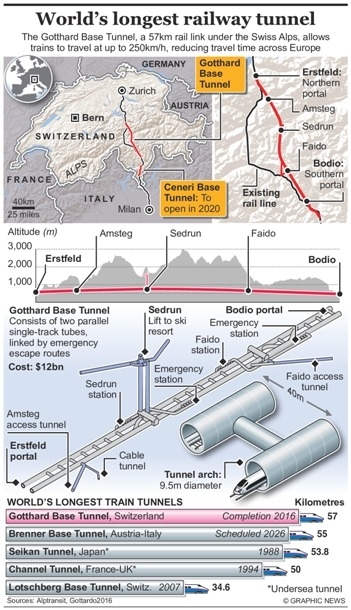
The famed Gotthard Base Tunnel (GBT) has started regular commercial rail service in Switzerland. It is the first regular train to use GBT ferried passenger from Zurich to Lugano. The twin-bore GBT is the world’s longest and deepest railway tunnel with a length of 57-kilometer.
  • Key facts:
  • It is the first flat low-level route through the Alps Mountain and is a part of Swiss government’s New Railway Link through the Alps (NRLA) programme.
  • It has not only outdone the 50.5 kilometre long Channel Tunnel connecting Britain and France but has also beaten Japan’s 53.9 kilometre long Seikan tunnel. 
  • It took 17 years to reach completion and its total cost amounts to around US $11.8 billion.
  • It comprises two single-track tunnels that connect the municipalities of Erstfeld and Bodio in Switzerland. 
  • In comparison to earlier 180, now 260 freight trains would be able to pass through the Gotthard mountain range each day. 
  • The ambitious project is Swiss-funded and was made possible through advanced tunnel-boring machines.
The main purpose behind the construction of the tunnel was to do away with the cultural and trading barrier that the Alps posed as in Europe since centuries. Though the opening of the Gotthard road tunnel in 1980 made it possible for goods to be transported by road, fatal accidents and adverse environmental effects led the authorities to come up with the plan of building two base tunnels under the NRLA programme.
While GBT is the second tunnel to be built under the programme, the first was the 34.6 kilometres long Lotschberg base tunnel, which was opened for commercial services in December 2007.
​
Non-OPEC countries agree to cut oil production by 558000 barrels per day
  • For the first time since 2001, non-OPEC countries on December 10, 2016, agreed to join the supply cuts in order to overcome the major obstacle for a global agreement to curb output. The decision was taken during a meeting of the Organization of Petroleum Exporting Countries (OPEC) in Vienna.
  • These eleven oil-producing countries, who are not members of the OPEC oil cartel, include Azerbaijan, Oman, Mexico, Sudan, South Sudan, Bahrain, Malaysia, Equatorial Guinea, Bolivia, Kazakhstan and Russia.
Breakdown proposed by non-OPEC countries
  • Russia to cut 300000 barrels a day
  • Mexico to cut 100000 barrels a day
  • Kazakhstan to cut 50000 barrels a day
  • Oman to cut 45000 barrels a day
  • Azerbaijan to cut 35000 barrels a day
  • Malaysia to cut 35000 barrels a day
  • Bahrain to cut 12000 barrels a day
  • Equatorial Guinea to cut 12000 barrels a day
  • South Sudan to cut 8000 barrels a day
  • Brunei to cut 7000 barrels a day
  • Bolivia to cut 4000 barrels a day
  • Sudan to cut 4000 barrels a day
Civil nuclear cooperation agreement signed between India and Vietnam
  • To enhance the bilateral ties between the two nations, India and Vietnam on December 9, 2016, signed a civil nuclear cooperation agreement.  This is the second nuclear pact signed by India within a month. Earlier in November 2016, India signed a similar civil nuclear agreement with Japan.
  • Vietnam is the 14th country with which India signed the civil nuclear deal.
  • Apart from this civil nuclear agreement, the two nations also signed three other agreements to enhance aviation links, to jointly work in the area of energy efficiency and promotion of parliamentary cooperation.

MODEL QUESTIONS FOR IPO EXAM PAPER IIII

(Indian Constitution)

1. Indian Republic is not the product of—
(A) Political Revolution(B) Discussion(C) Made by a body of eminent representatives of the people(D) All the above

2. For the first time, British Parliament enacted which laws for the British Government to govern in India—
(A) Govt. of India Act 1857(B) Govt. of India Act 1858(C) Govt. of India Act 1891(D) Govt. of India Act 1888

3. The British Secretary of the State governed India through which Institution—
(A) Executive Council(B) Parliament(C) Governor assisted by an Executive Council
(D) Governor General appointed by an Executive Council

4. Under the British Rule in India, Governor General was responsible to—
(A) Secretary of India(B) Secretary of Britain(C) Secretary of State(D) None of the above

5. Morely-Minto reform is associated with which Act—
(A) Indian Council Act 1856(B) Indian Council Act 1909(C) Indian Council Act 1908(D) Indian Council Act 1912

6. During the British rule, which community got separate representation from which Act—
(A) Christian Community & Indian Council Act 1909(B) Buddhist Community & Indian Council Act 1907
(C) Muslim Community & Indian Council Act 1909(D) All the above

7. During the British period, under which Act election was introduced in India—
(A) Indian Council Act 1913(B) Indian Council Act 1909(C) Indian Council Act 1906(D) Indian Council Act 1907

8. Montagu-Chelmsford report is associated with which Govt of India Act—
(A) Govt. of India Act 1918(B) Govt. of India Act 1920(C) Govt. of India Act 1930(D) Govt. of India Act 1919

9. When was the Indian National Congress established—
(A) 1888(B) 1885(C) 1889(D) 1890

10. Under the British Rule when ‘Dyarchy Governing System’ was introduced for the first time—
(A) Govt. of India Act 1919(B) Govt. of India Act 1929(C) Govt. of India Act 1925(D) Govt. of India Act 1935

11. Under the Govt. of India Act 1935, which communities were provided separate representation in the Electorate system—
(A) Sikh, Europeans(B) Indian Christians(C) Anglo-Indians(D) All the above

12. Under which Government of India Act, Federation and Provincial Autonomy were introduced in India—
(A) Govt. of India Act 1935(B) Govt. of India Act 1930(C) Govt. of India Act 1940(D) Govt. of India Act 1936

13. Under the British rule, how many acts came into operation—
(A) Govt. of India Act 1858, Indian Council Act 1861(B) Indian Council Act 1892, Indian Council Act 1809
(C) Govt. of India Act 1919, Govt. of India Act 1935, Indian Independence Act 1947(D) All the above

14. Which Act provided India to become an Independent state—
(A) Indian Independence Act 1949(B) Indian Independence Act 1946(C) Indian Independence Act 1947(D) None 

15. Under the Govt. of India Act 1935, the Indian Federation worked through which kind of list—
(A) Federal List(B) Provincial List(C) Concurrent List(D) All the above

16. In the Govt. of India Act 1835, Federal List contained which kind of subjects—
(A) External Affairs(B) Currency and Coinage(C) Naval, Military and Force, Census(D) All the above

17. In the Govt. of India Act 1935, provincial list included which kind of subjects—
(A) Police(B) Provincial Public Service(C) Education(D) All the above

18. In the Govt. of India Act 1935, which subjects are included in the concurrent list—
(A) Criminal Law & Procedure, Civil Procedure(B) Marriage(C) Divorce, Arbitration(D) All the above

19. Under the Govt. of India Act 1935, who had the power to proclaim emergency—
(A) Governor General(B) General of India(C) Governor of the State(D) None of the above

20. In the Govt. of India Act 1935, who was authorised to make a law on the Provincial subject—
(A) Governor(B) Governor General(C) Federal Legislature(D) None of the above

21. Which Constitution is in the written form for the first time by an elected body during the Modern period—
(A) India(B) America(C) Britain(D) France

22. Who was the de facto Prime Minister at the time of evolution of the Indian Constituent Assembly—
(A) Moti Lal Nehru(B) Sardar Ballabh Bhai Patal(C) Jawahar Lal Nehru(D) H. N. Kunzru

23. Who boicotted the Indian Constituent Assembly—
(A) Unionist Muslim(B) Muslim League(C) Unionist Scheduled Caste(D) Krishak Poja


24. In the Constituent Assembly, which parties were members—
(A) Congress, Muslim League, Unionist Muslim(B) Unionist Scheduled Caste, Krishak Poja, Scheduled Castes Federation, Sikh (Non Congress)(C) Communists, Independents(D) All the above
25. Which party said that Indian Constituent Assembly does not have a fully representative character—
(A) Congress(B) Muslim League(C) Unionist Muslim(D) Unionist Scheduled Castes

26. After independence, who decided to determine the Future Constitution of India—
(A) Jawahar Lal Nehru(B) Sardar Ballabh Bhai Patel(C) Constituent Assembly(D) None of the above

27. Whom the Indian Constituent Assembly represented—
(A) Fully representative of the Hindus(B) Fully representative of the State in India
(C) Fully representative of the Provinces in India(D) Fully representative of the States and Provinces in India

28. Through which offer, the British Government authoritatively supported a Constituent Assembly for making the Indian Constitution(A) August offer(B) Viceroy offer(C) Sir Strafford Cripps offer(D) None of the above

29. Who supported the views of the Constituent Assembly for making the Indian Constitution—
(A) Sardar Patel(B) Gandhiji(C) Jinnah(D) None of the above

30. Gandhiji wrote which article in the Harijan of 19th November 1939 to support the formation of Constituent Assembly for making the Constitution of India—(A) The need of Constitution(B) Formation of Constituent Assembly(C) The only way(D) The way

31. Which Party supported formation of a Constituent Assembly—
(A) Congress(B) Muslim League(C) Unionist Muslim(D) Unionist Scheduled Castes

32. When did Constituent Assembly adopt a national Flag—
(A) 22nd Aug. 1947(B) 22nd July 1947(C) 22nd Jan. 1947(D) 22nd Oct. 1947

33. Did the Constituent Assembly exist at the time of Indian Independence—
(A) No(B) Only idea emerged(C) Yes(D) Uncertainty regarding formation of said Assembly

34. Who was the last British Governor General who addressed the Constituent Assembly—
(A) Lord Attlee(B) Lord Mount Batten(C) Lord Bentick(D) None of the above

35. When did the Constituent Assembly passed a resolution for translation of the Constitution of India into Hindi and other many languages of India—(A) 17th Sep. 1949(B) 17th Oct. 1949(C) 17th Nov. 1949(D) 17th Dec. 1949

36. What was the last session of the Constituent Assembly—
(A) Eleventh session(B) Twelfth session(C) Sixteenth session(D) Seventh session

37. When was the last Twelfth session of the Constituent Assembly held—
(A) 24th Jan. 1950(B) 24th Feb. 1950(C) 24th April 1950(D) 24th Dec. 1950

38. How many copies of the Constitution were printed after the Constituent Assembly framed the same—
(A) Two(B) One(C) Three(D) Four

39. Which song was sang in the Constituent Assembly before its Adjournment sine die—
(A) Jana Gana Man(B) Vande Matram(C) A & B(D) None of the above

40. For how many years, months and days, did the Constituent Assembly work on the Constitution of India—
(A) 2 Years, 11 months and 19 Days(B) 3 Years, 12 months and 16 Days(C) 4 Years, 18 months and 6 Days
(D) None of the above

41. How many number of sessions were held in the Constituent Assembly—
(A) Twenty sessions(B) Twelve sessions(C) Twenty-five sessions(D) Twenty-eight sessions

42. How many Articles and Schedules were in the First Draft Constitution presented by the Drafting Committee to the Constituent Assembly—
(A) 318 Articles and 7 Schedules(B) 319 Articles ad 10 Schedules(C) 315 Articles and 8 Schedules
(D) 399 Articles and 5 Schedules

43. In the final form of the Constitution adopted by the Constituent Assembly, how many Articles and Schedules were there—(A) 397 Articles and 9 Schedules(B) 395 Articles and 4 Schedules(C) 396 Articles and 7 Schedules
(D) 395 Articles and 8 Schedules

44. In the Constituent Assembly how many total number of Amendments were proposed in the Draft Constitution—
(A) Approx. 7935(B) Approx. 7892(C) Approx. 7365(D) Approx. 2473

45. What was the expenditure made by the Constituent Assembly while framing the Constitution of India—
(A) Rs. 63,96,729(B) Rs. 64,98,725(C) Rs. 69,92,769(D) Rs. 65,92,926

46. How many visitors came to witness the proceedings of the Constituent Assembly—
(A) 52,500(B) 53,000(C) 54,000(D) 54,500

47. Who presented the Objective Resolution in the Constituent Assembly—
(A) Jawaharlal Nehru(B) Motilal Nehru(C) Sardar Ballabah Bhai Patel(D) None of the above
48. When was the First Draft of the Constitution of India proposed—
(A) Oct. 1945(B) Oct. 1947(C) Oct. 1946(D) Oct. 1948
49. Who prepared the first draft Constitution of India—
(A) Jawahar Lal Nehru(B) Gandhiji(C) Advisory Branch of the Constituent Assembly(D) Sardar Ballabh Bhai Patel

50. Who was the Chairman of the Draft Committee of the Constituent Assembly—
(A) Dr. B. R. Ambedkar(B) K. M. Munshi(C) Jagjivan Ram(D) None of the above

51. When was the draft Constitution of India prepared by the Drafting Committee submitted to the President of the Constituent Assembly—
(A) 28th Feb. 1948(B) 26th Feb. 1948(C) 21st Feb. 1948(D) 25th Feb. 1948

52. When was the Second Reading of the Constitution completed in the Constituent Assembly—
(A) 18 Nov. 1949(B) 17 Nov. 1949(C) 15 Nov. 1949(D) 16 Nov. 1949

53. How many readings were held on the Constitution in the Constituent Assembly—
(A) First Reading(B) Third Reading(C) Second Reading(D) None of the above

54. When was the Constitution of India adopted by the Constituent Assembly—
(A) 25th Nov. 1949(B) 29th Nov. 1949(C) 26th Nov. 1949(D) 27th Nov. 1949

55. How many Princely States existed at the time when the Constituent Assembly was making the Constitution—
(A) 600(B) 800(C) 900(D) 950

56. Who said, ‘I feel, however, good a Constitution may be, it is sure to turn out bad because those who are called to work it, taken to be a bad lot. However bad a Constitution may be, it may turn out to be good if those who are called to work it, happens to be a good lot. The working of a Constitution does not depend wholly upon the nature of the Constitution’—
(A) Dr. Ambedkar(B) Dr. Rajendra Prasad(C) Dr. Subhash Kashyap(D) None of the above

57. Who stated, ‘As to the execution that the Draft Constitution has produced a good part of the provisions of the Government of India Act 1935, make no apologies. There is nothing to be ashamed of in Borrowing.’—
(A) Dr. Rajendra Prasad(B) Jawhar Lal Nehru(C) Gandhiji(D) Dr. Ambedkar

58. Who said, ‘If the people who are elected are capable and men of character and integrity, they would be able to make the best even of a defective Constitution. If they are lacking in these, the Constitution cannot help the country’—
(A) Sardar Hukam Singh(B) K. M. Munshi(C) Dr. Rajendra Prasad(D) Sardar Ballabh Bhai Patel

59. When were the election to the Constituent Assembly held—
(A) July 1946(B) Aug. 1946(C) Sep. 1946(D) Oct. 1946

60. In the Constituent Assembly how many seats were got by the Congress—
(A) 204(B) 205(C) 203(D) 208

61. How many seats were obtained by the Muslim League in the Constituent Assembly—
(A) 74(B) 75(C) 73(D) 76

62. How many seats were acquired by the other parties in the Constituent Assembly—
(A) 14(B) 15(C) 17(D) 18

63. How many total members were elected in the Constituent Assembly—
(A) 296(B) 293(C) 291(D) 292

64. In the Parliament of India Upper House in known as—
(A) Lok Sabha(B) Rajya Sabha(C) Council of States(D) None of the above

65. In the Parliament, Lower House is called as— (A) Legislative Assembly(B) Legislative Council(C) Rajya Sabha
(D) Lok Sabha (House of People)

66. In the Constituent Assembly who was the Head of the Union Constitution Committee—
(A) Jawaharlal Nehru (B) Sardar Patel(C) Subhash Buse(D) None of the above

67. In the Constituent Assembly which words were associated with the Parliament—
(A) Parliament of the Legislature(B) Parliament of the Union(C) Parliament of the Federation(D) All the above

68. In the Constituent Assembly, it was said that Parliament of the Federation shall consist of the President and what else—
(A) National Legislature(B) National Assembly(C) House of People(D) Council of State

69. In the Constituent Assembly, which committee recommended that Indian Constitution adopt Parliamentary Form of Executive—
(A) Drafting Committee(B) Constitutional Committee(C) Union Constitution Committee(D) All the above

70. In the Constituent Assembly, how many seats were fixed for House of People—
(A) 500(B) 400(C) 300(D) 250
71. In the Constituent Assembly, what was the number of population fixed for one Representative—
(A) 7,500(B) 7,50,000(C) 50,000(D) 78,500

72. Who elected Dr. Rajendra Prasad as the First President of India—
(A) Constituent Assembly(B) Legislative Assembly(C) Council of State(D) Lok Sabha

73. In the Constituent Assembly who proposed the name of Dr. Rajendra Prasad as President of India—
(A) Jawaharlal Nehru(B) Sardar Patel(C) A & B(D) None of the above

74. Which is our National anthem—
(A) Jana Gana Mana(B) Vande Matram(C) A & B(D) None of the above

75. When did the Constituent Assembly adopt National Anthem—
(A) 25th Jan. 1950(B) 26th Jan. 1950(C) 24th Jan. 1950(D) 29th Jan. 1950

76. In the last session of the Constituent Assembly which song was sung—
(A) Jan Gana Mana(B) Vande Matram(C) A & B(D) None of the above

77. Which women presented National Flag in the Constituent Assembly—
(A) Smt. Sarojini Naidu(B) Smt. Hansa Mehta(C) Smt. Indira Gandhi(D) None of the above

78. In the Indian National Flag, what does Ashoka’s wheel represent—
(A) Wheel of the Truth(B) Wheel of the Moral(C) Wheel of the Dharm(D) Wheel of the Law

79. In the National Flag, what does green colour represent—
(A) Animals(B) Soil(C) Human Nature(D) Spiritual Philosophy

80. In the National Flag, what does saffron colour represent—
(A) Spirit of Renunciation(B) Spirit of colours(C) Spirit of Human nature(D) None of the above

81. In the National Flag, whom does the wheel represent—
(A) Prithivi Raj Chauhan(B) Raja Man Singh(C) Ashoka(D) None of the above

82. In the National Flag, what shall be the Ratio of the width to the length—
(A) 2 : 3(B) 2 : 4(C) 2 : 5(D) 2 : 6

83. In the National Flag, how many colours are there—
(A) Four(B) Three(C) Two(D) Five

84. Which colours are included in the National Flag—
(A) Deep Saffron(B) White(C) Dark Green(D) All the above

85. In the National Flag, which colour is used in the wheel—
(A) Blue(B) Navy Blue(C) Red Green(D) Green-White

86. In the Constituent Assembly, when was the ad-hoc Committee appointed for the National Flag—
(A) 23rd June 1947(B) 23rd July 1947(C) 23rd Jan. 1947(D) 23rd Feb. 1947

87. What was the name of India’s First Legislature—
(A) Parliament(B) Union Parliamen(C) Constituent Assembly(D) National Assembly.

88. During what period, Constituent Assembly of India worked—
(A) 1948-1950(B) 1949-1951(C) 1947-1949(D) 1951-1952

89. Who was the first Speaker of free India’s first Legislature (Constituent Assembly)
(A) G. V. Mavalankar(B) K. M. Munshi(C) Frank Anthony(D) Smt. Sarojini Naidu

90. After Indian Independence who represented Provisional Parliament—
(A) Lok Sabha(B) Parliament(C) Rajya Sabha(D) Constituent Assembly

91. When did India become a fully Sovereign Democratic Republic—
(A) 26th Nov. 1949(B) 26th Nov. 1930(C) 26th Jan. 1949(D) 26th Nov. 1951

92. After Indian Independence, what was not Provisional Parliament provided—
(A) Directly Elected Body(B) Indirectly Elected Body(C) Sovereign Body(D) None of the above

93. In the Provisional Parliament of India, how many members were there—
(A) 296(B) 313(C) 318(D) 316

94. In India who amended the Constitution through the first Amendment Bill 1951—
(A) Lok Sabha(B) Rajya Sabha(C) Provisional Parliament(D) Parliament

95. Who was the first Prime Minister of India at the time of Provisional Parliament—
(A) Jawahar Lal Nehru(B) Lal Bahadur Shastri(C) Indira Gandhi(D) Rajiv Gandhi

96. Who was be Deputy Prime Minister of India at the time of Provisional Parliament—
(A) Jawahar Lal Nehru(B) Sardar Ballabh Bahi Patel(D) Maulana Abdul Kalam Azad(D) Gulzarilal Nanda

97. Which occupation was represented more in the Provisional Parliament—
(A) Agriculturists(B) Businessmen(C) Teachers/Academicians(D) Lawyers

98. From which area, more members were represented in the Provisional Parliament—
(A) Rural area(B) Urban area(C) Municipalities(D) Panchayats

99. When did the first Lok Sabha function—
(A) 1952-1956(B) 1953-1957(C) 1952-1957(D) None of the above

100. Who was the Prime Minister of India in the first Lok Sabha—
(A) Pandit Govind Ballabh Pant(B) Jawahar Lal Nehru(C) Abdul Kalam Azad(D) C. D. Deshmukh

Answers :
1.(A) 2.(B) 3.(D) 4.(C) 5.(B) 6.(C) 7.(B) 8.(D) 9.(B) 10.(A) 11.(D) 12.(A) 13.(D) 14.(C) 15.(D) 16.(D) 17.(D) 18.(D) 19.(A) 20.(C) 21.(B) 22.(C) 23.(B) 24.(D) 25.(B) 26.(C) 27.(D) 28.(A) 29.(B) 30.(C) 31.(A) 32.(B) 33.(C) 34.(B) 35.(A) 36.(B) 37.(A) 38.(C) 39.(C) 40.(A) 41.(B) 42.(C) 43.(D) 44.(C) 45.(A) 46.(B) 47.(A) 48.(B) 49.(C) 50.(A) 51.(C) 52.(D) 53.(B) 54.(C) 55.(A) 56.(A) 57.(D) 58.(C) 59.(A) 60.(B) 61.(C) 62.(A) 63.(D) 64.(B) 65.(D) 66.(A) 67.(C) 68.(A) 69.(C) 70.(A) 71.(B) 72.(A) 73.(C) 74.(C) 75.(C) 76.(C) 77.(B) 78.(D) 79.(B) 80.(A) 81.(C) 82.(A) 83.(B) 84.(D) 85.(B) 86.(A) 87.(C) 88.(C) 89.(A) 90.(D) 91.(C) 92.(A) 93.(B) 94.(C) 95.(A) 96.(B) 97.(D) 98.(A) 99.(C) 100.(A)
Dec 13, 2016

SSC Stenographer Grade 'C' & 'D' Examination 2016 - Final Answer Keys and OMR Answer Sheets

Staff Selection Commission (SSC) has published Final Answer keys and OMR Answer Sheets for the post of Stenographer Grade 'C' & 'D' Examination 2016 , Check below for more details.

Final Answer keys and OMR Answer Sheets : Click Here

Result : Click Here